
The following research and analysis was commissioned by Homewatch CareGivers.
Along with the pleasures and rewards of aging comes the unfortunate business of becoming more susceptible to injuries. But knowing how and where injuries are most likely to happen can help seniors to avoid them.
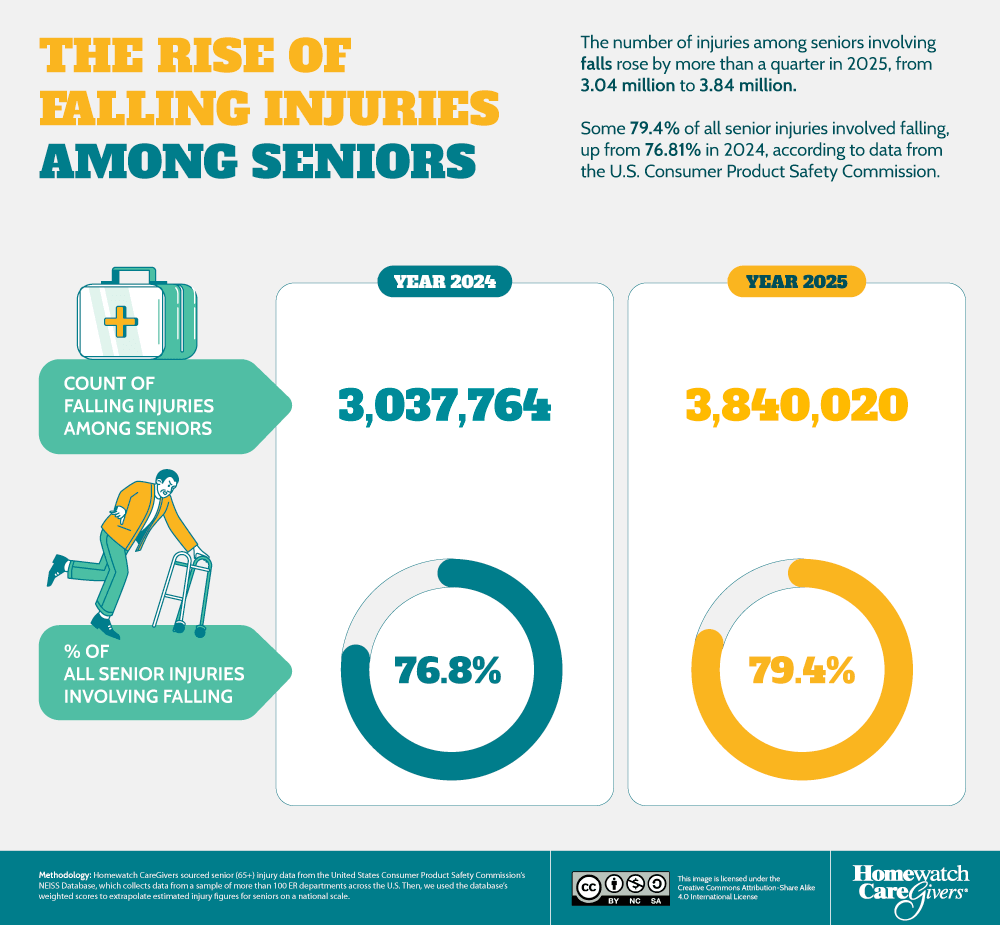
Seniors tend to experience more serious injuries due to “greater frailty, loss of muscle mass and fragile bones,” according to Dr. Andrew Rundle, an epidemiologist at Columbia University. A U.S. senior falls every second, and an older person who falls is six times more likely to need emergency room treatment. According to our latest research, falls caused 79.4% of senior injuries in 2025 — but they are far from the only danger.
Homewatch CareGivers wants to share a clear picture of the locations and household rooms where senior injuries happen and the nature of the most common accidents and injuries. So, we extrapolated data from the United States Consumer Product Safety Commission’s NEISS Database on injuries to seniors (aged 65+) from 100 U.S. ER departments to estimate injury figures on a national scale.
Key Findings
-
Seniors incurred 2.6 million injuries in the home in 2025 — accounting for 72.53% of all senior injuries.
-
Some 79.4% of injuries to seniors involve a fall.
-
Senior injuries involving Electric Mobility Carts (including mobility scooters and electric wheelchairs) rose by 236.7% in 2025, the fastest rise for any product-related injury.
-
The bathroom is where 46.1% of senior injuries occur, and bathroom injuries rose by more than 90,000 in 2025.
-
The head is the most commonly injured body part among seniors, accounting for 26.72% of all body part injuries in 2025.
Three-quarters of Senior Injuries Occur in the Home
First, we identified where injuries occur most frequently and how that frequency has changed over time.
We found that the home is the most common place for senior injuries, with nearly three-quarters (72.53%) of senior injuries with an identified location happening here. There were 2.6 million such injuries in 2025, which is an increase of 29.3%, or nearly 600,000 from the previous year.
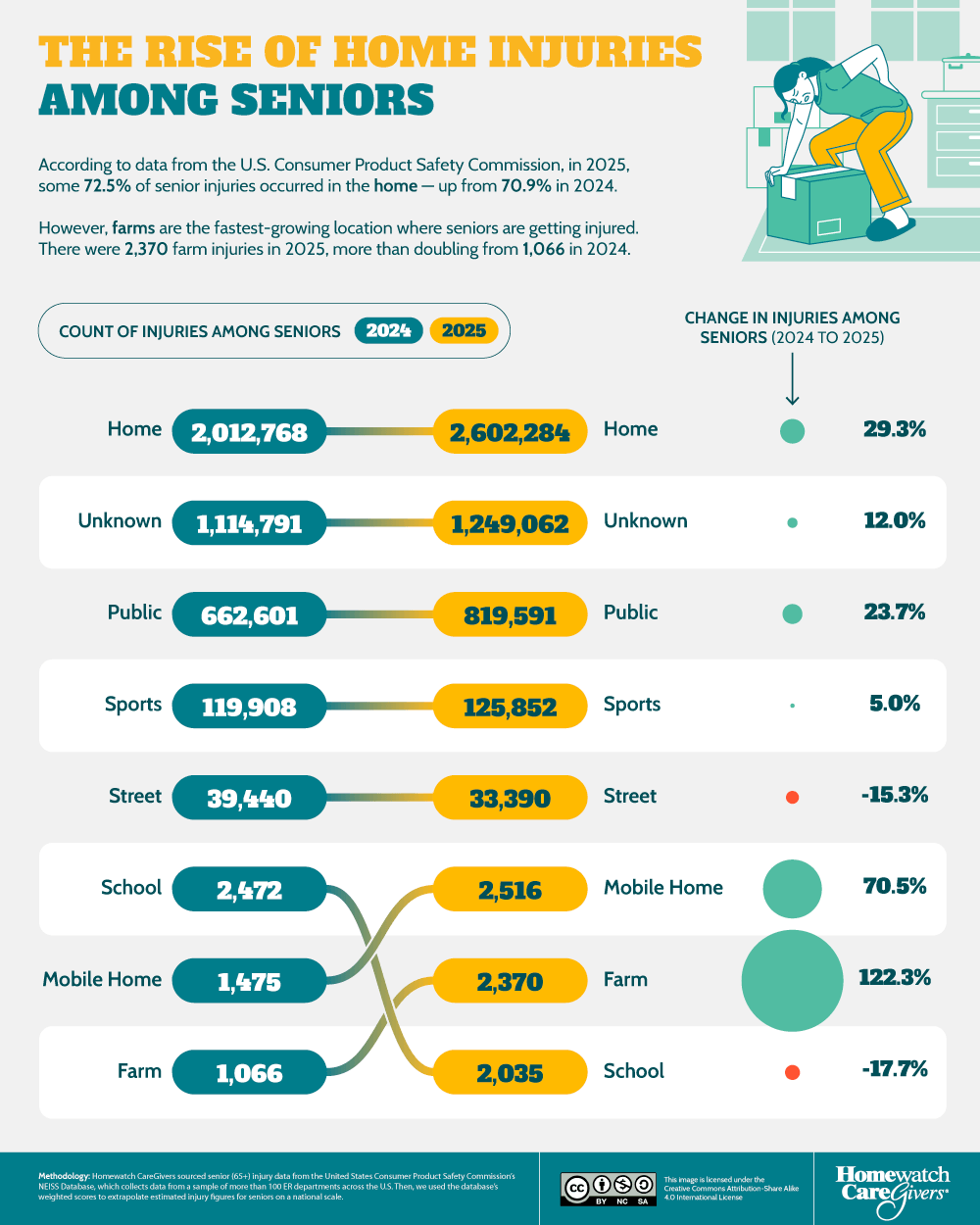
However, the fastest-growing location for seniors to incur injuries is the farm. Farm injuries more than doubled from 1,066 in 2024 to 2,370 in 2025, a 122.3% increase. Still, such injuries account for just 0.07% of senior injuries overall.
Home Injuries Most Likely to Happen to Seniors in the Bathroom
With three-quarters of senior injuries occurring in the home, we took a closer look at which rooms they are most likely to happen in.
Nearly half of injuries to seniors at home occur in the bathroom. There were an estimated 325,177 bathroom injuries in 2025, up from 234,337 in 2024. In 2025, bathroom injuries accounted for 46.1% of home injuries with a known location, up from 44.0% the previous year.
The kitchen was the second most common room for injuries, with kitchen injuries rising by 54% to 90,849. There were just 609 more injuries in the kitchen than on the stairs.

Living room and bedroom injuries increased at an even faster rate than those in the kitchen. Bedroom injuries nearly doubled to 19,808 in 2025, while living room injuries rose by 8,427 to 19,034, an increase of 126%.
Injuries Involving Electric Mobility Carts More Than Tripled
"It’s a fact that older adults are far more likely to experience a significant injury, or fatality, from the hidden hazards associated with consumer products in their homes than other age groups,” CPSC Chair Alex Hoehn-Saric told the National Council on Aging.
Our analysis shows that domestic floors are far and away the most common “object” involved in injuries to seniors, with the number of such injuries rising by 84.3% to 1,337,921 in 2025. This was during a period when the number of falls rose by 26.4%. By way of comparison, the next most dangerous object or product is the Snow/Ice Removal Tool, involved in 11,375 senior injuries in 2025.
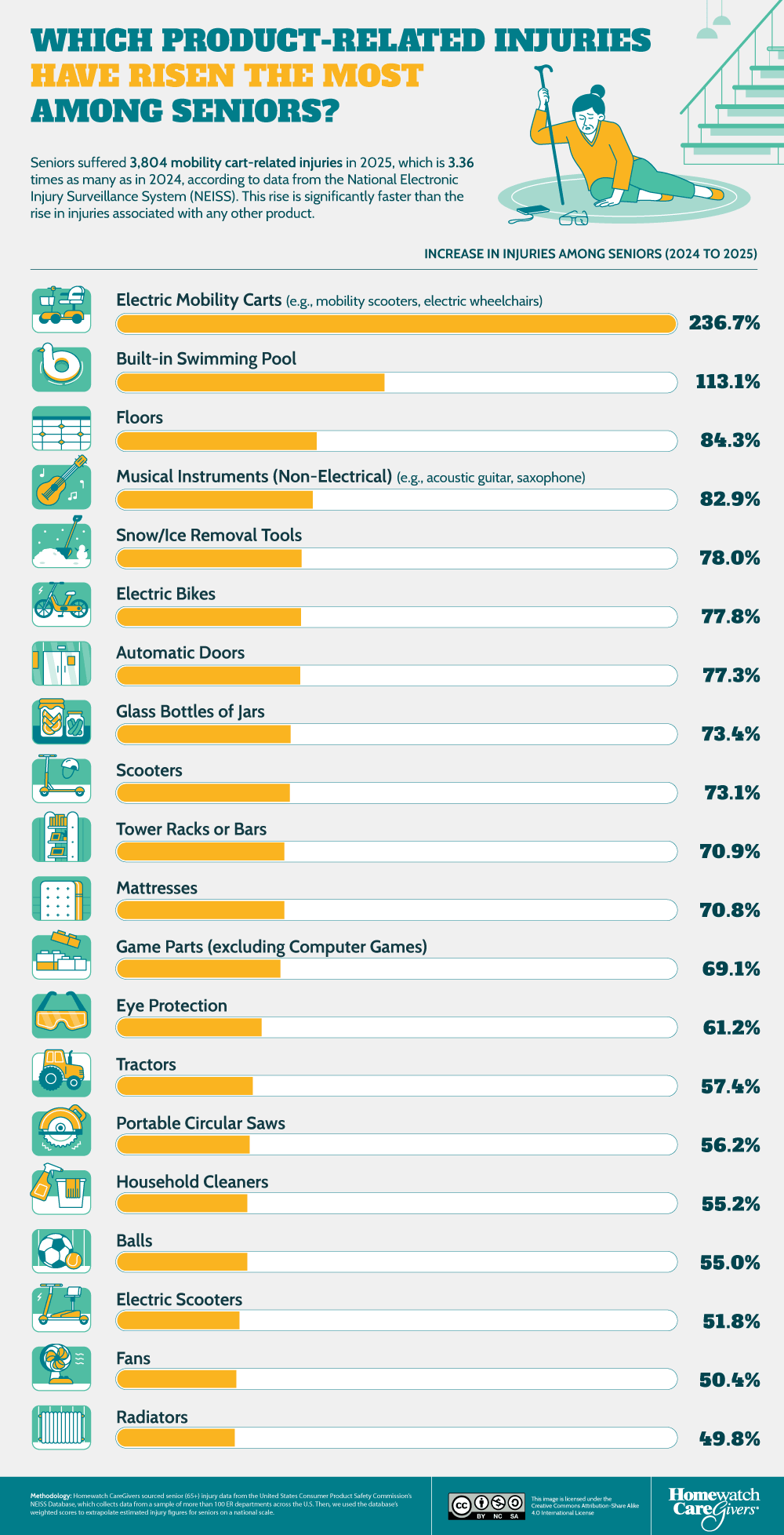
However, the number has doubled for injuries involving Built-in Swimming Pools and more than tripled for injuries related to Electric Mobility Carts. In this latter case, the number of injuries rose from an estimated 1,130 to 3,804 in 2025, based on the number of such injuries reported at a cross-section of 100 U.S. emergency rooms.
Over a Quarter of Senior Injuries Affect the Head
Next, we looked at the results of these injuries, starting with the body parts most frequently affected.
Seniors are most likely to injure the head, with 1.2 million head injuries among seniors in 2025, a rise of 27.0%. Altogether, head injuries account for 26.72% of all identified body part injuries in 2025.
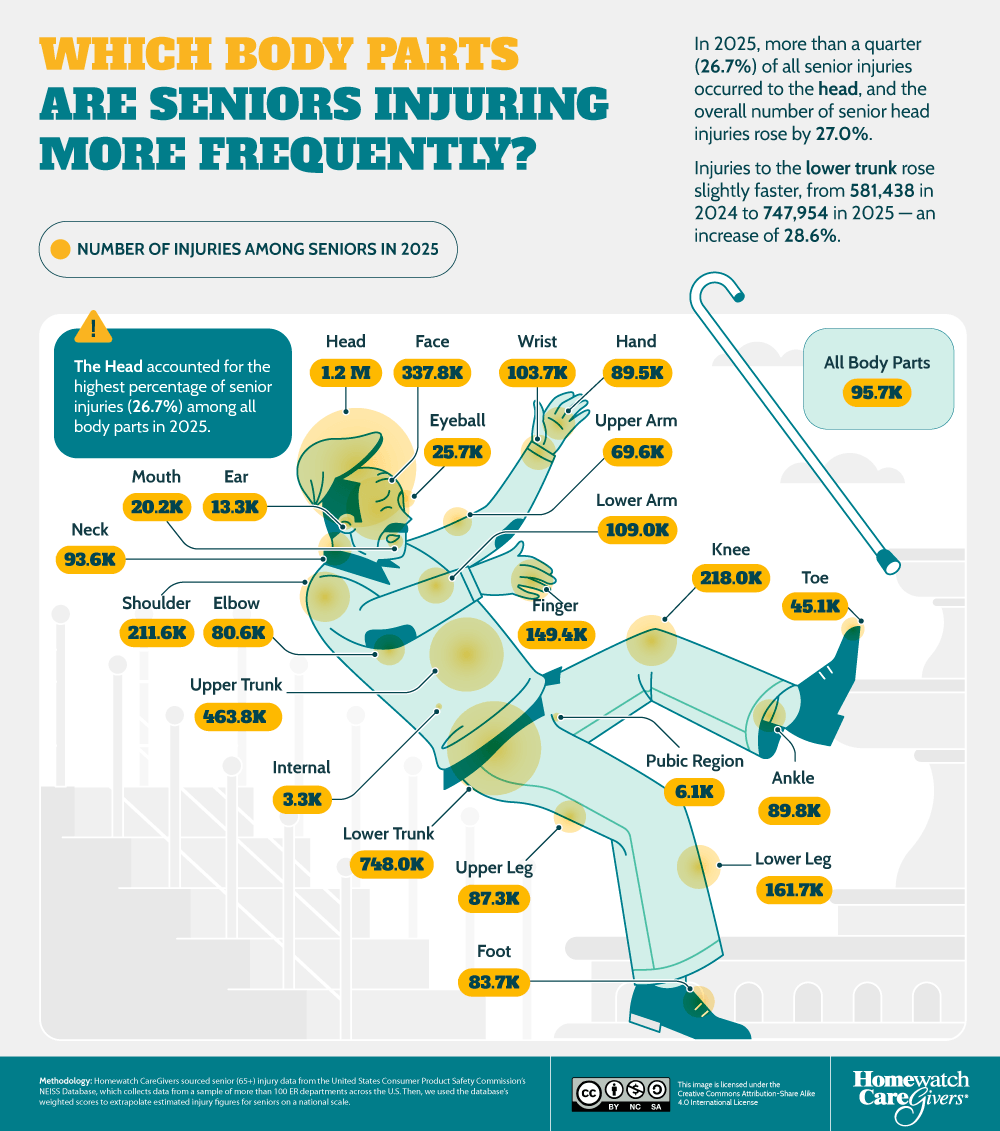
The lower and upper trunk are categorized as separate body parts; otherwise, combined, they would account for more injuries than the head. However, the lower trunk — where seniors suffered 748,000 injuries in 2025, a rise of 28.6% — is the fastest-rising area of complaint.
The number of internal injuries actually fell by 17.8% in 2025, from 4,000 to 3,300.
Fractures are the Most Common Diagnosis Among Seniors
The most common specific diagnosis for injured seniors in 2025 was “fracture,” with an estimated 1.03 million fractures occurring in the U.S. among this age group — or more than one-fifth of all diagnoses. This is an increase of 21.7% year on year.
The fastest-rising diagnosis was “hemorrhage,” up 58.5% from 7,633 in 2024 to 12,102 diagnoses in 2025. However, this still accounts for just 0.25% of all diagnoses.
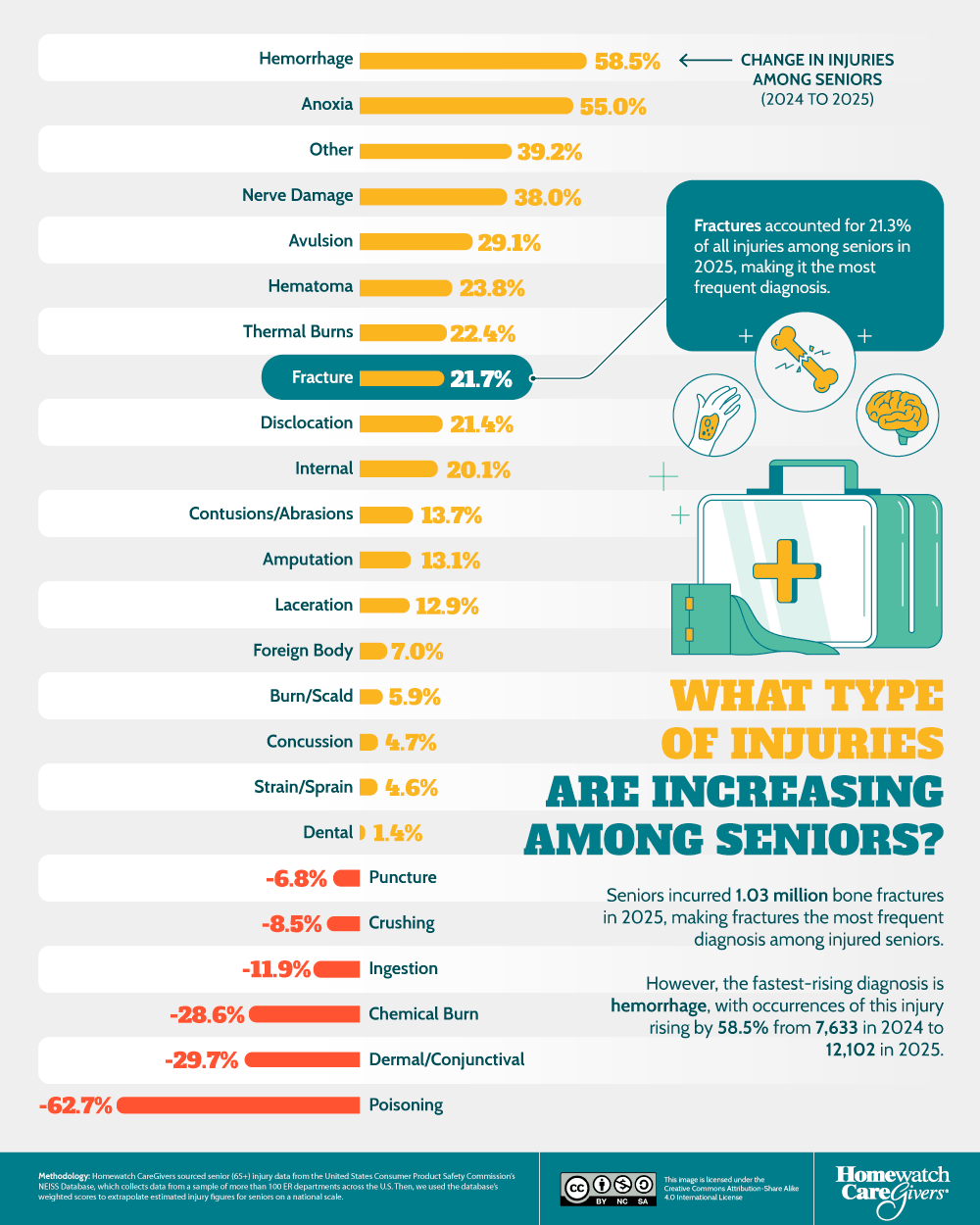
Several forms of diagnosis actually fell in frequency in 2025, including chemical burn (28.6% fewer diagnoses compared to 2024) and dermal/conjunctival (29.7% fewer).
However, instances of poisoning fell by 62.7% from 33,667 to 12,565 in this period, the biggest decline of any injury-related diagnosis among seniors. While poisoning previously accounted for 0.85% of senior injuries, in 2025 this figure fell to just 0.26%.
How to Avoid Injury as a Senior
The National Institute on Aging suggests the following precautions to help seniors avoid accidents and injuries:
-
Stay active. Moving regularly helps maintain muscle levels and keeps you flexible. It may help delay bone loss from osteoporosis. Find out more in our guide to safe exercise for seniors.
-
Install fall-proof aids at home. Add handrails where appropriate, ensure adequate lighting and install motion-activated lighting. Keep floors clear and carpets firmly fixed down. Be prepared and read our advice on what to do after the first fall.
-
Get adequately equipped. Choose low-heeled, non-slip shoes for outdoors, and wear reliable slippers when climbing stairs indoors. Seek professional advice on obtaining an appropriate cane or walker.
-
Pay attention to your health and fitness. Know your limits, including getting your eyes and ears tested regularly. Take the time to learn about the side effects listed on your medications.
-
Sleep well and stay away from alcohol. A clear head can help you stay upright and avoid mistakes.
-
Don’t go out in dangerous conditions. Bad weather and slippery floors (particularly on outside decking or sidewalks) are not worth the risk. Wait until conditions improve, or seek assistance to make things safe or get around.
Methodology
We sourced senior (65+) injury data from the United States Consumer Product Safety Commission’s NEISS Database, which collects data from a sample of more than 100 ER departments across the U.S. Then, we used the database’s weighted scores to extrapolate estimated injury senior figures on a national scale.
About Homewatch CareGivers
Founded in 1980, Homewatch CareGivers is a leading provider of in-home care services for people of all ages through a network of more than 300 locations. Caregivers are triple-screened and continually trained and supervised to provide reliable, compassionate and highly skilled services in companion, personal and comprehensive care. With over 20,000 clients served and an average review of 4.8/5 across all locations, Homewatch CareGivers is one of the most trusted networks of full-service home care providers. It has earned national recognition, including ranking among the top 10 senior care companies on Entrepreneur Magazine's Franchise 500 list and receiving three distinguished Franchise Update Media Innovation Awards for its innovation with Homewatch CareGivers Total Care Solutions®, Homewatch Connect™ and Certified Dementia Care Specialist Training program. Each location is independently owned and operated by a franchisee, and services may vary by location with some locations providing only nonmedical care services. Homewatch CareGivers is part of the Authority Brands family. For more information, visit www.homewatchcaregivers.com or follow on Facebook, Instagram, and LinkedIn.