
The following research was commissioned by Homewatch CareGivers.
Financial scammers often target seniors because they believe that older people may have more money to extract. Regardless of whether this is true about one target or another, becoming a fraud victim can cause upset, embarrassment, and economic hardship, according to the National Council on Aging.
Scams affect the generations differently, according to the Federal Trade Commission, and online shopping scams and business or government imposters are among the most prevalent scams targeting seniors.
To track the risk of financial scamming on seniors across the country, Homewatch CareGivers analyzed data from the Better Business Bureau’s Scam Tracker. We identified the scams that tend to target seniors and found the prevalence and cost of these scams among Americans of all ages around the country.
What We Did
We sourced scam data from the Better Business Bureau’s Scam Tracker for the period of January 1st to August 24th, 2026, focusing on the categories of scams most likely to target seniors based on reports from the National Council on Aging (NCOA) and the Center for Retirement Research. Then, we used this data to calculate the rate of scams per 100,000 people in each state and 25 major cities and the money lost in each state and city. All figures refer to reports submitted by victims and reviewed by BBB and include reports from victims of all ages, not just seniors.
Key Findings
-
Online Purchase scams are the most prevalent type of scam among those that commonly target seniors, and Americans reported 53,934 such scams in the first eight months of 2026.
-
Better Business Bureau data shows victims lost $27.5 million to Investment scams and $25 million to Online Purchase scams between January and August 2026.
-
Las Vegas is the major city where scams likely to target seniors are most common — with 97 such scams per 100,000 people reported to the Better Business Bureau over an eight-month period.
-
Scams of categories that commonly target seniors cost victims in Houston over $1 million in the first eight months of 2026.
Online Purchase Fraud and Phishing Accounts are Most Prevalent Scams Among Those Targeting Seniors
First, we found the number of new reports submitted to the Better Business Bureau of each type of scam before removing those that are less likely to target senior citizens.
Among scams commonly targeting seniors, Online Purchase fraud is most prevalent, with 53,934 reports to the Better Business Bureau among all age groups between January 1st and August 24th, 2026. This is twice as many as the second most prevalent, Phishing, with 27,389 reports during this period. Phishing is, in turn, three times more common than Counterfeit Product scams (9,340).
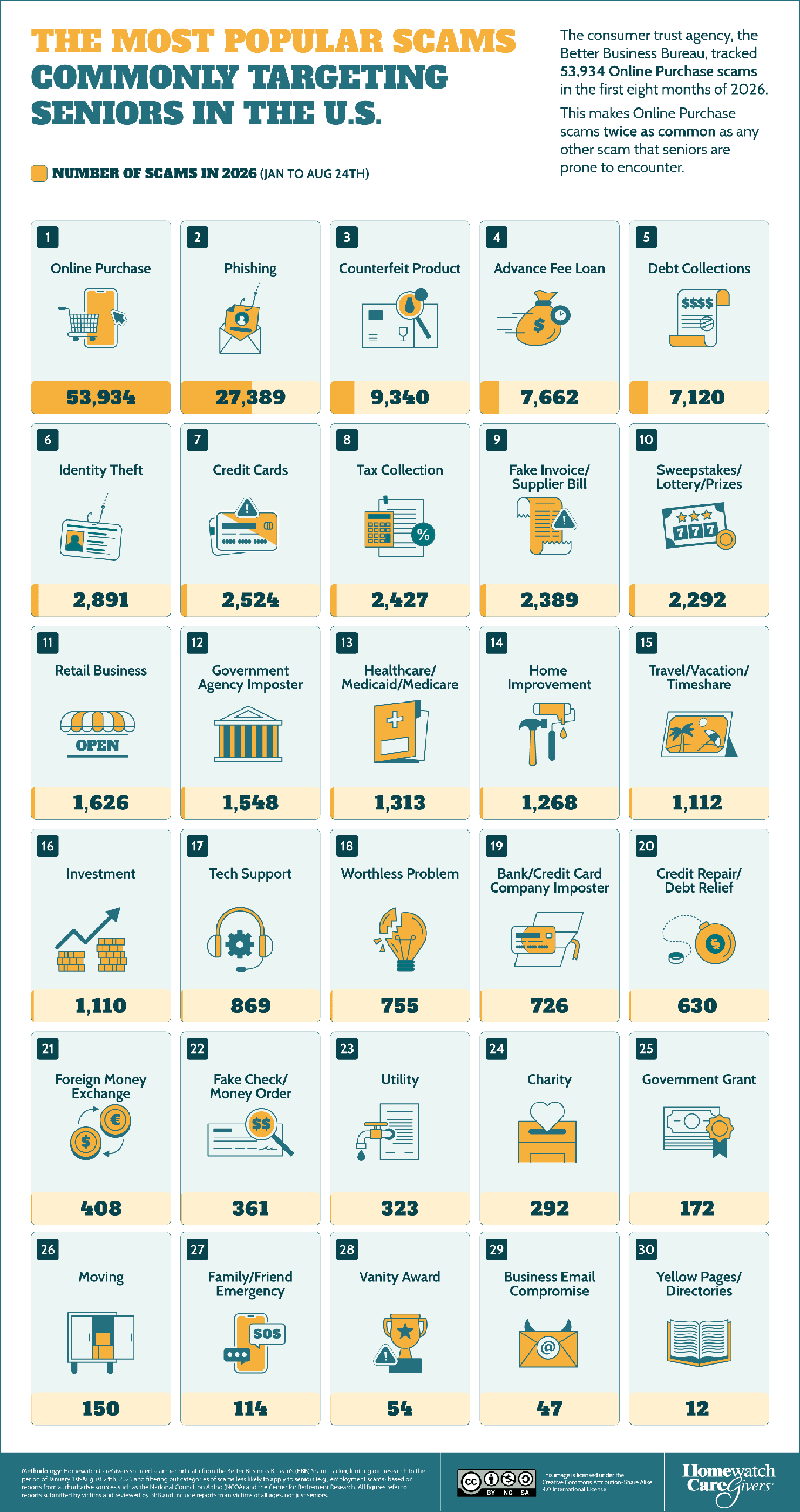
Phishing “is a type of cyberattack that uses fraudulent emails, text messages, phone calls or websites to trick people into sharing sensitive data,” as defined by IBM. It is a common form of cyber fraud because, rather than rely on technical trickery, fraudsters exploit human nature to extract passwords or bank details from their victims. Together, Online Purchase fraud and Phishing account for 64% more scams than those in the other categories combined.
Investment Scams Cost American Consumers $27.5 million in Eight Months
Next, we calculated how much money Americans have lost to scams that commonly target seniors.
Although Online Purchase fraud and Phishing are the most commonly reported scams targeting seniors, Investment scams cost Americans more money. The Better Business Bureau tracked 1,110 Investment scams in our data period, and there were 15 types of scams that were more prevalent than this. But because of the high figures involved in investment scams, the total reported loss equals $27.5 million — three times the cost of Phishing to scam victims and dozens of times the cost of most other fraud types.
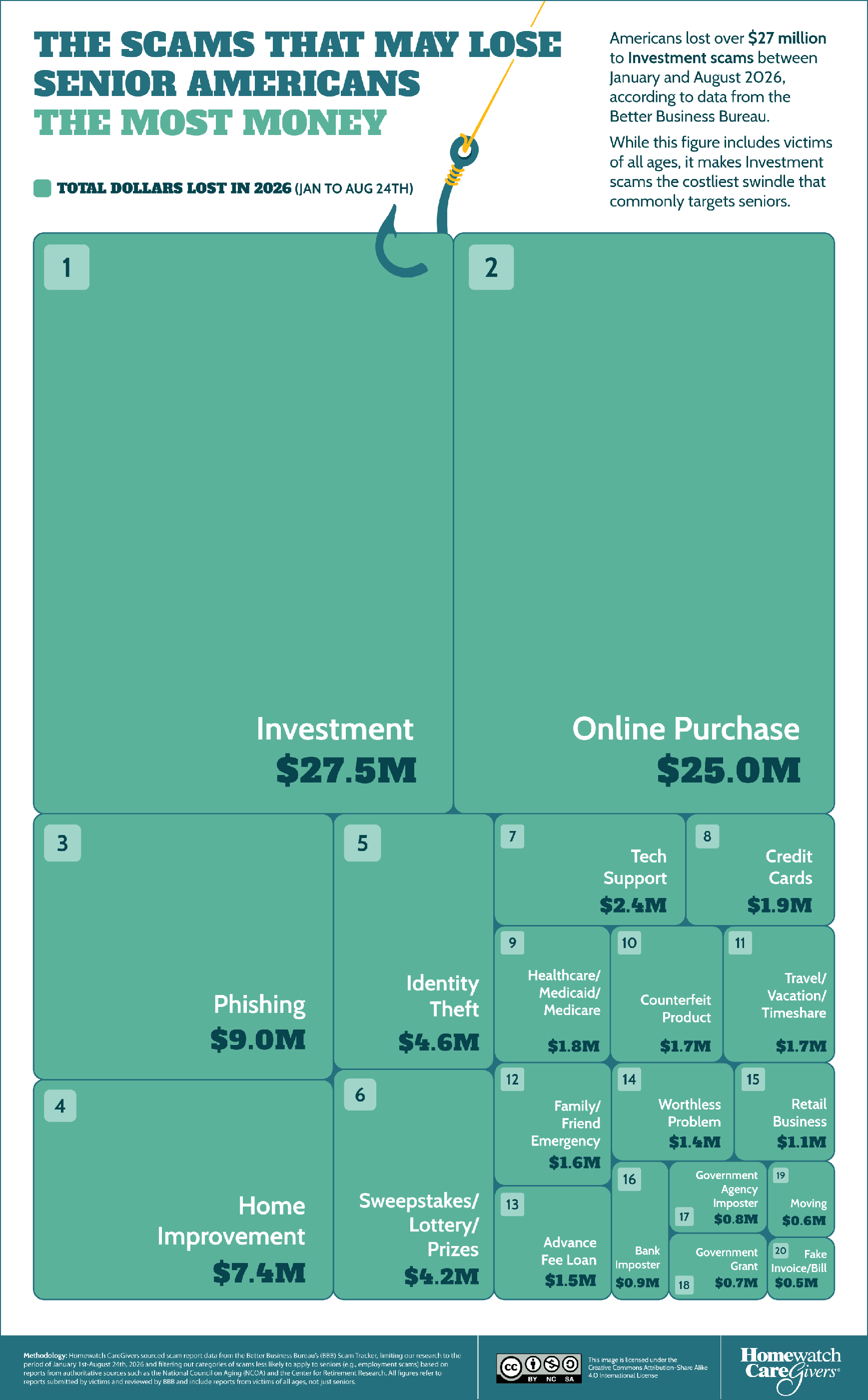
However, the sheer number of Online Purchase scams puts their cost in the same ballpark as that of Investment fraud. There were nearly 49 times as many Online Purchase scams as Investment scams in our reporting period, but the cost of Online Purchase scams to victims was $2.5 million less, at $25 million.
New Hampshire and Las Vegas Report Most Scams Per Person
Next, we filtered our analysis to reveal local trends. We compared the number of reported scams to the local population in every state and 25 major cities in the first eight months of 2026.
In New Hampshire, victims reported 816 scams known to target seniors. With a population of 1,415,342, that makes 58 scams per 100,000 residents. This is the highest figure for any state. Texans reported more than 11 times as many scams in absolute terms (9,307), but Texas actually has the lowest rate of scams when compared to population, at just 29 per 100,000 people.
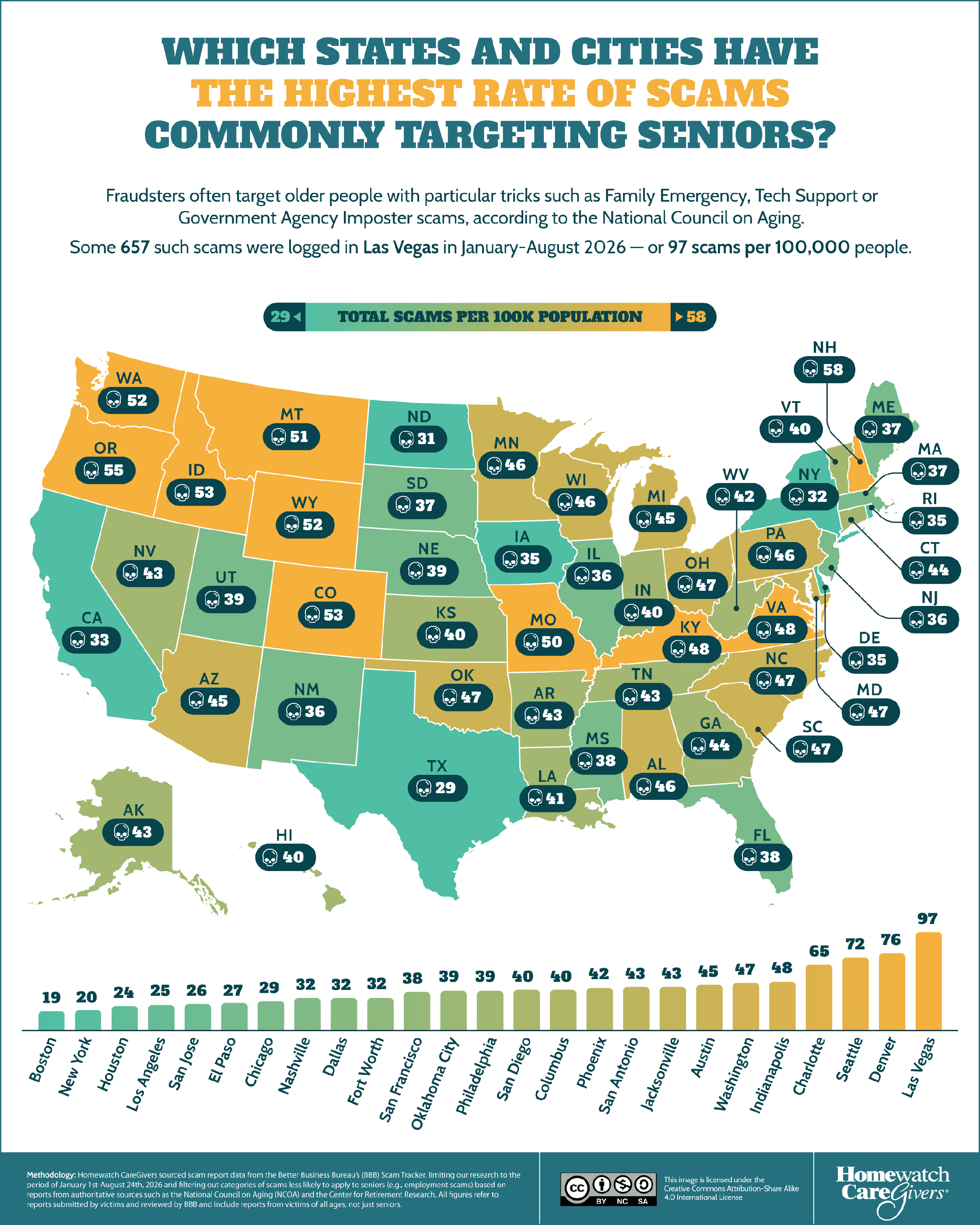
Las Vegas is the city with the highest rate of scams commonly targeting seniors compared to population, at 97 per 100,000 residents — almost one per 1,000 residents. Of the 25 major cities we analyzed, New York has the most scam reports in total, some 1,748 in eight months. However, this works out at just over 20 per 100,000 people. Only Boston had a lower per-capita scam rate.
Investment Fraud Costs Californians Nearly $3 million in Eight Months
Finally, we identified the scam type that caused the biggest dollar losses in each state and major city so far in 2026.
In California, Investment fraud cost consumers $2.8 million across the first eight months of 2026. This is the biggest total cost reported for a specific scam type in any state. Victims in Florida and Texas also incurred losses totalling over $2 million in each state.
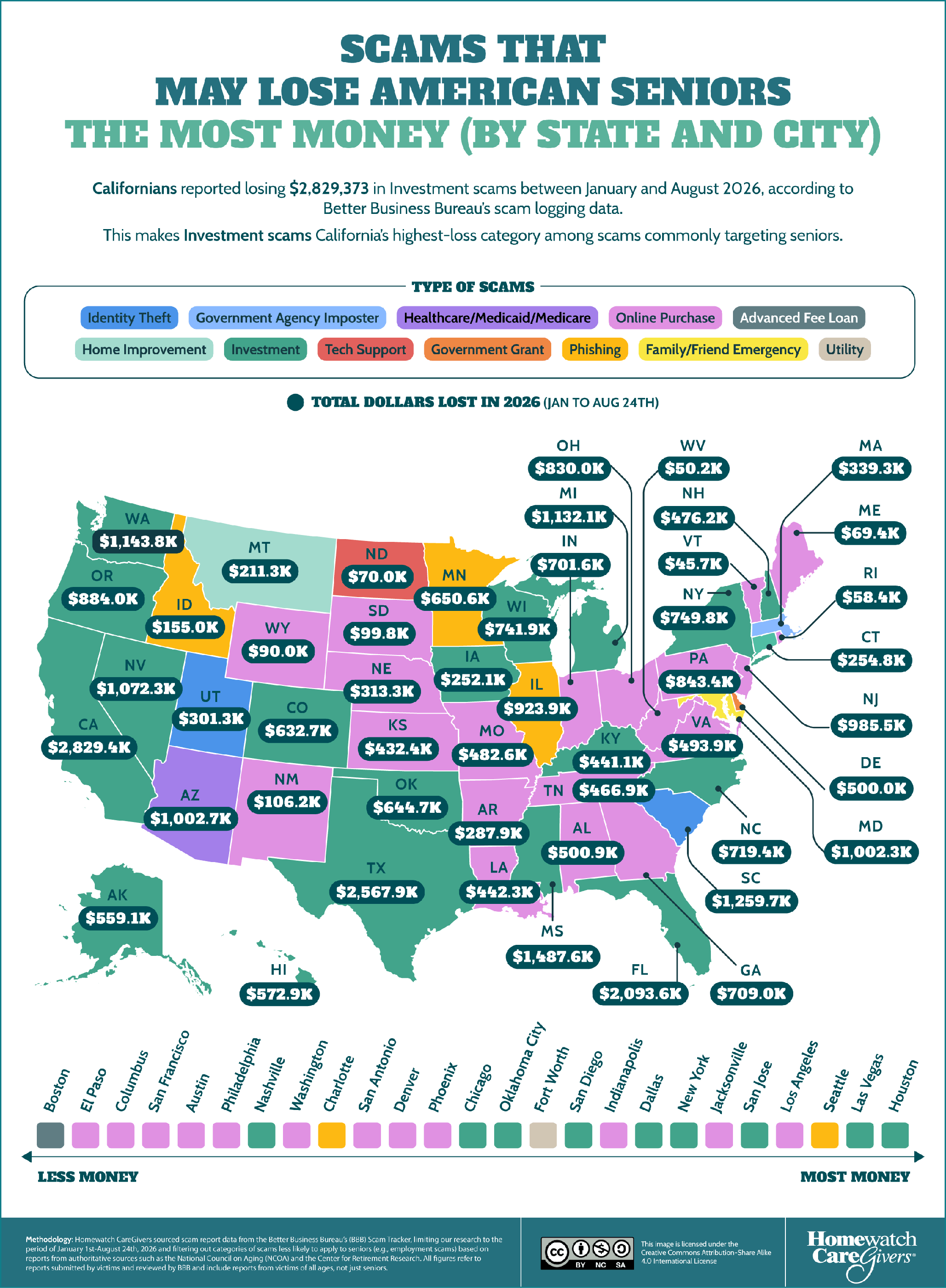
Among major cities, Houston and Las Vegas followed the state-level trend, each suffering their highest losses — and the highest of these 25 major cities — through Investment fraud. In Houston, that cost was $1,009,000, accounting for 39% of the total losses to Investment fraud in Texas. The city with the biggest losses for a scam that wasn’t Investment fraud was Seattle, where consumers lost $620,649 to Phishing scams during this period.
5 Tips to Help Seniors Avoid Scams
The National Council on Aging has detailed guides on identifying and avoiding specific types of scam that target seniors, but to stay safe, here are some general principles to follow:
1. Act With Caution
When offered a deal that seems too good to be true, it probably is. Slow down and don’t let a potential scammer rush you into a decision.
2. Verify Their Identity
If somebody asks you for money or personal details, contact them or their organization using contact details you know to be legitimate — even if it appears to be someone you know, such as a relative.
3. Ask Someone You Trust
Before sharing personal details, sending money, or clicking on a link in an unusual email, speak to a carer or family member who can advise you if it’s safe.
4. Be Twice as Cautious With Money Transfers
Look out for surprising requests or unusual forms of money transfer, even if the logo or identity of those making the request seems familiar.
5. Report Suspicious Activity
If you’ve been scammed or believe somebody tried to scam you, report it to the police and contact other relevant bodies to get support and help protect others.
Unfortunately, as technology develops, the sophistication and frequency of scams continue to rise. In 2026, AI tools can help fraudsters produce scams that are very difficult to spot. Make sure to read our guide on signs of a scam seniors need to know to help your loved one avoid getting scammed.
Methodology
We sourced scam data from the Better Business Bureau’s Scam Tracker, limiting our research to the period of January 1st to August 24th, 2026.
We used authoritative sources such as the National Council on Aging (NCOA), the Center for Retirement Research, and the New York State Department of State to build a seed list of the most common scams targeting seniors. With this information, we filtered out categories of scams in the BBB’s dataset that were less likely to apply to seniors (e.g., employment scams) and focused on those more likely to be targeting them.
Using the ZIP codes and Dollars Lost data from each scam report, we calculated the rate of scams per 100k population for each state and 25 major cities. We also identified the scam type that accounted for the most money lost in each state and city.
Data is correct as of August 2026.
About Homewatch CareGivers
Founded in 1980, Homewatch CareGivers is a leading provider of in-home care services for people of all ages through a network of more than 300 locations. Caregivers are triple-screened and continually trained and supervised to provide reliable, compassionate and highly skilled services in companion, personal and comprehensive care. With over 20,000 clients served and an average review of 4.8/5 across all locations, Homewatch CareGivers is one of the most trusted networks of full-service home care providers. It has earned national recognition, including ranking among the top 10 senior care companies on Entrepreneur Magazine's Franchise 500 list and receiving three distinguished Franchise Update Media Innovation Awards for its innovation with Homewatch CareGivers Total Care Solutions®, Homewatch Connect™ and Certified Dementia Care Specialist Training program. Each location is independently owned and operated by a franchisee, and services may vary by location with some locations providing only nonmedical care services. Homewatch CareGivers is part of the Authority Brands family. For more information, visit www.homewatchcaregivers.com or follow on Facebook, Instagram, and LinkedIn.