
The following research was commissioned by Homewatch CareGivers.
Good dementia advice can help families, caregivers and clients understand their situation better for daily challenges and long-term decision-making.
Unfortunately, although many helpful dementia resources are available, the nature of the internet means you may also find people sharing information that is inaccurate and even dangerous.
One such source of misleading information — presented with the best of intentions or otherwise — is TikTok. Dementia content has racked up billions of views on the short video platform. But in some cases, misleading TikTok videos can lead to unnecessary anxiety, misdiagnosis, expense, and interference with treatment.
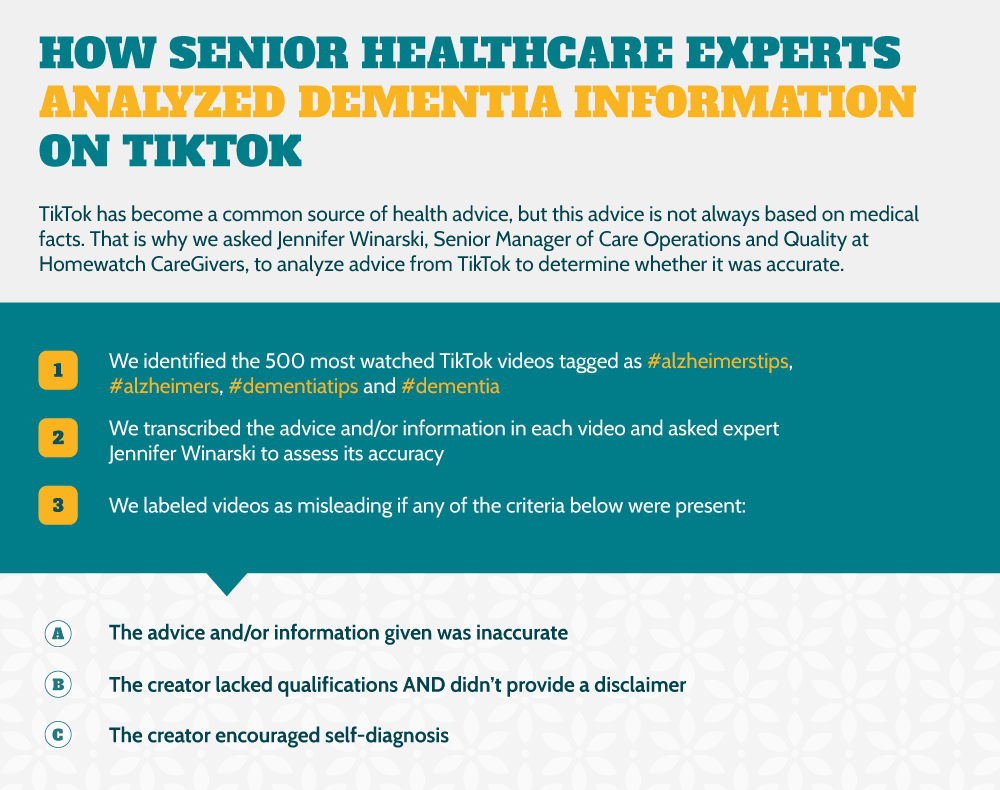
To assess the scale of the issue, Homewatch CareGivers studied a sample of 500 of the most watched dementia-themed videos. We tagged the ones that provided advice and asked expert Jen Winarski, Senior Manager of Care Operations and Quality at Homewatch CareGivers, to determine which ones were accurate, inaccurate or potentially damaging. (You can read more about Jen’s credentials as a dementia expert in the full methodology at the end of this article.)
Key Findings
-
66.4% of the top dementia-themed TikTok videos contain misleading information.
-
Nearly half (47.6%) of the misleading dementia-themed videos feature potentially damaging advice.
-
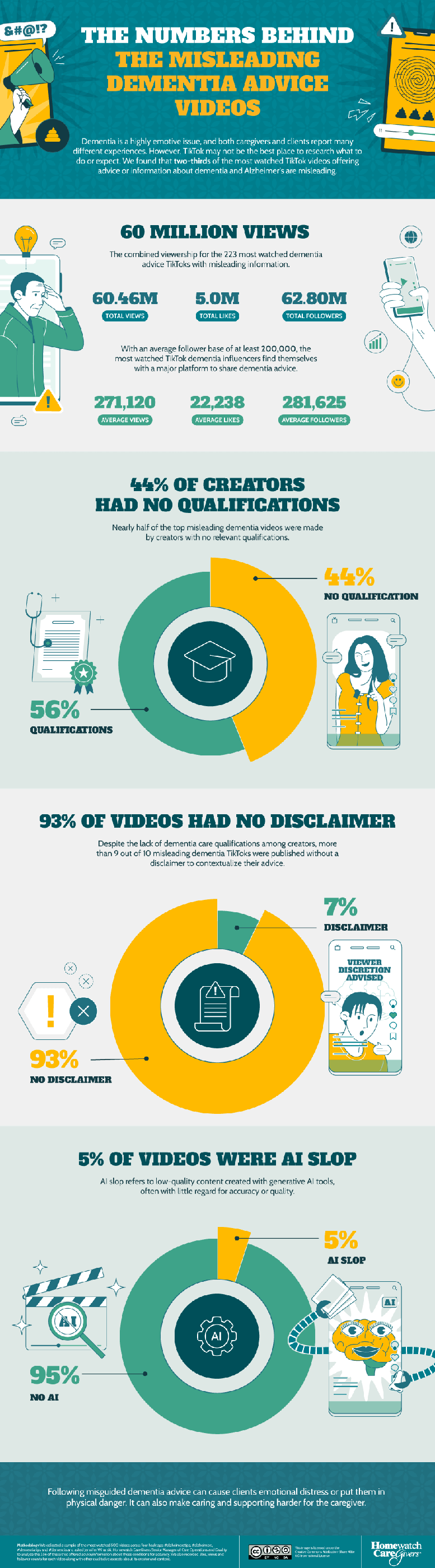
The 223 most watched dementia TikToks have been seen by a combined audience of over 60,459,674 viewers.
-
44% of the creators of misleading dementia videos had no relevant qualifications.
Two-Thirds of Dementia Advice TikToks Offer Misleading Information or Advice
First, we analyzed the 500 most watched TikTok videos featuring any of these four hashtags: #alzheimerstips, #alzheimers, #dementiatips and #dementia, allowing for a maximum of one video per creator.
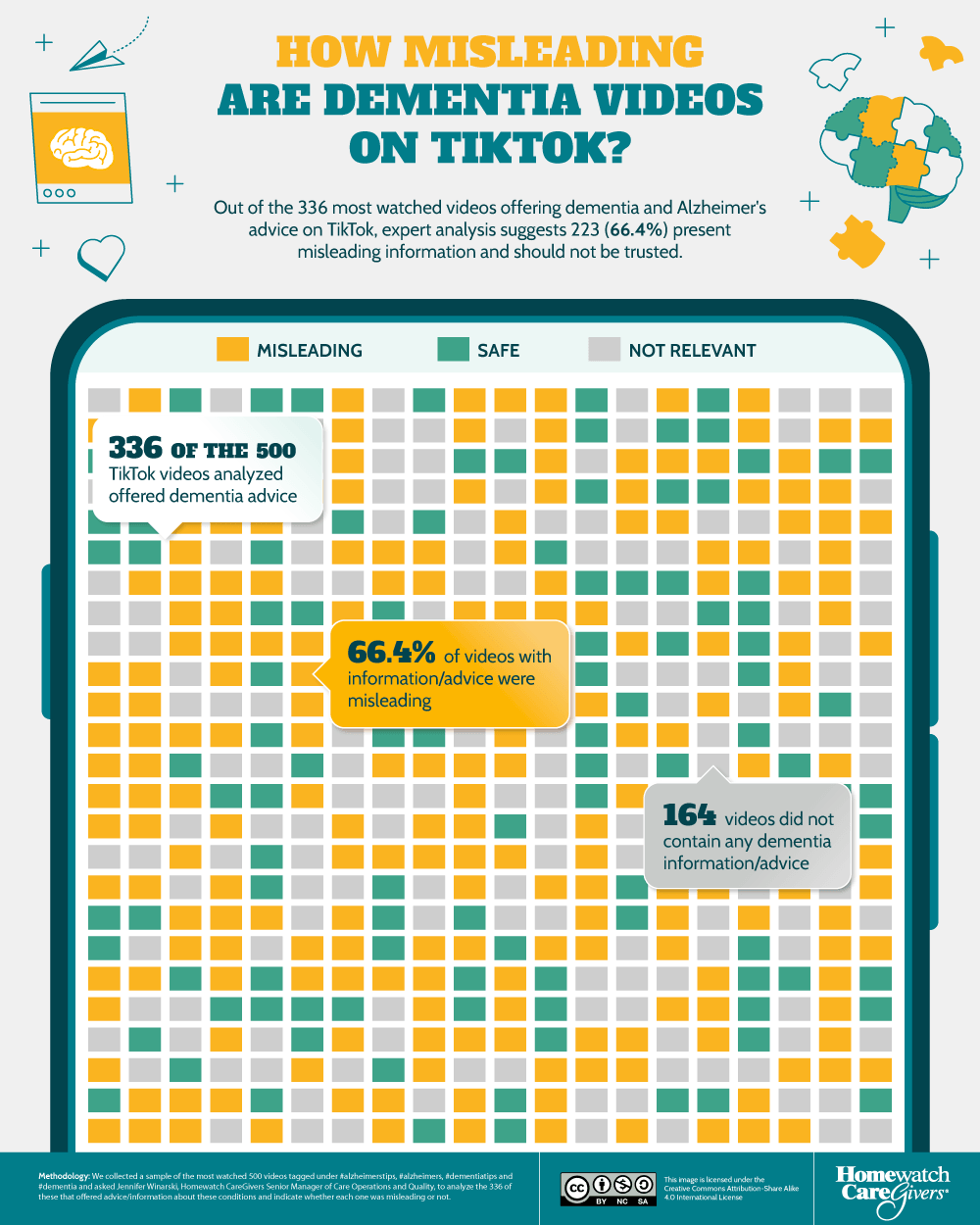
Of these 500 videos, we found that 336 offered actionable advice on dementia. And of these 336 TikTok videos, 223 (or 66.4%) offered advice that was misleading.
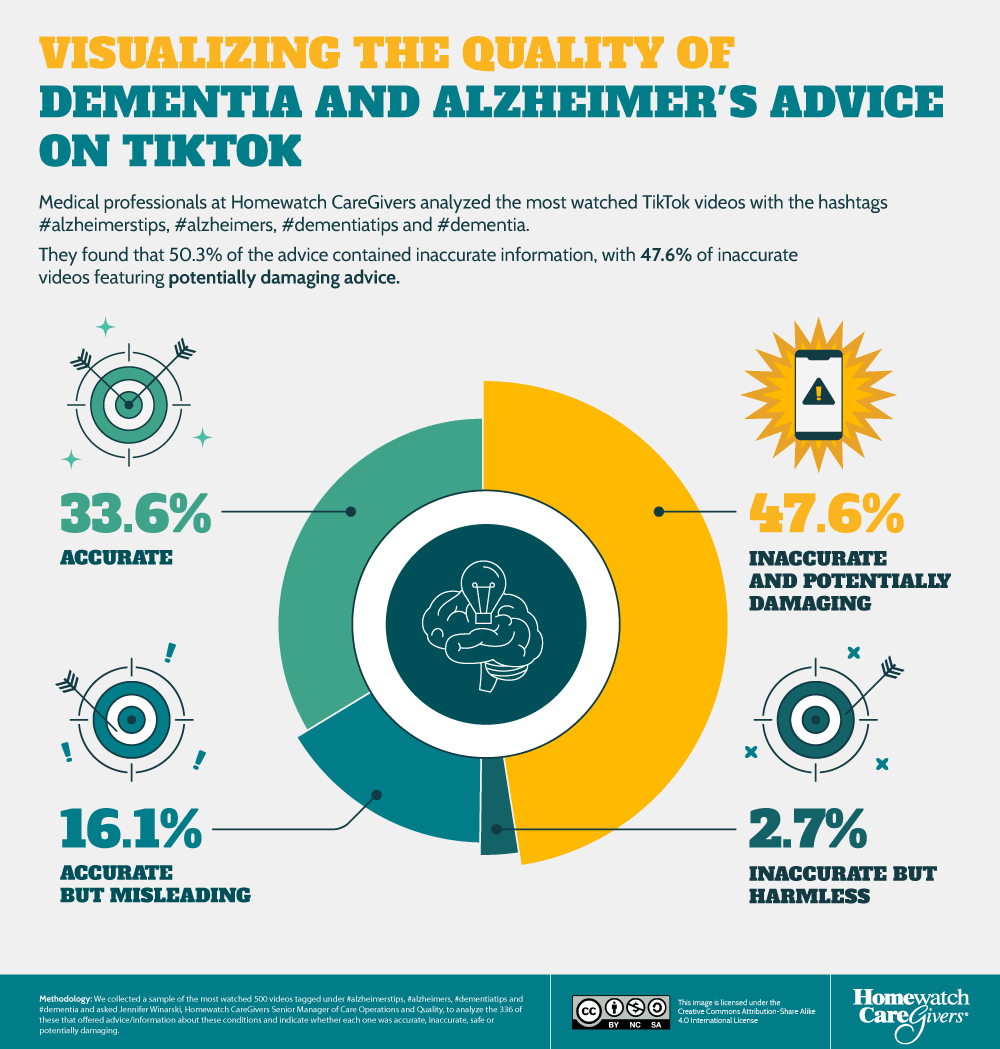
Next, we further broke this down to assess the accuracy of the videos. While two-thirds of the top dementia advice videos offered misleading advice or information, 47.6% offered inaccurate and potentially damaging information. Another 2.7% were inaccurate but not so as to be potentially damaging.
Inaccurate advice might involve suggesting remedies that are either unproven (and may distract from accessing real treatments) or may potentially have negative effects on someone living with dementia. And we found that a good share of the misleading dementia advice found on TikTok is based on personal opinion rather than proven fact. In a few cases, advice was given as being helpful, specifically for those living with dementia, when it may be general good health advice.
The Top 200 Dementia TikTok Channels Have Nearly 63 Million Followers
Finally, we highlighted some of the numbers behind our research.
We found that the creators behind the 223 most watched misleading dementia advice videos have an average of 200,000 followers each. Together, these videos had a combined view count of 60,459,674 at the time of analysis. Although most (93%) of the videos did not feature a disclaimer, nearly half (44%) were delivered by creators without the appropriate qualifications to advise on dementia care.
Some of this misleading or inaccurate advice may be well-intended. But it highlights the need to be scrupulous when accessing medical advice online, particularly on social media, and to verify information before acting on it.
The National Institute on Aging suggests that, as a rule, “health websites sponsored by federal government agencies are accurate sources of information.” They also suggest asking your health care provider for reliable sources of online information. Ask who made the content and if it has been expert-reviewed. Alzheimer's Research UK abides by the principle that dementia information should be evidence-based, up to date and reviewed by people living with or supporting those with dementia as well as medical experts.
However, it may not always be obvious that advice or information is being imparted. Some videos purport to share the experience of caring for somebody living with dementia, which can help both the creator and a viewer in a similar position feel seen.
However, many such videos may be filmed or shared without the consent of the person with the dementia diagnosis. They may also provide a one-sided view of the situations that can crop up or “falsely create the idea that there is only one way to have dementia,” according to MIT Technology Review’s A.W. Ohlheiser. This may perpetuate the myths that exist around the condition and indirectly encourage viewers to use the same methods, even if they don’t seem to deliver explicit instructions on supporting a dementia diagnosis.
Methodology
To explore the accuracy of dementia and Alzheimer’s information on TikTok, we first collected a sample of the most watched 500 videos across four hashtags: #alzheimerstips, #alzheimers, #dementiatips and #dementia. We allowed one video per creator to avoid the bias of a single creator.
We then transcribed these videos and removed videos that didn’t offer advice or information about these conditions. This resulted in a dataset of 336 videos.
For each of these 336 videos, we recorded a series of metrics:
- The likes and views for the video and creator’s follower count.
- Whether or not the creator shared relevant qualifications.
- Whether there was a disclaimer.
- Whether the creator encouraged self-diagnosis.
The transcribed advice was then analyzed for accuracy by Jennifer Winarski, Homewatch CareGivers Senior Manager of Care Operations and Quality.
Videos were labeled as misleading if any of the following criteria applied:
- The advice and/or information given was inaccurate.
- The creator lacked qualifications AND didn't provide a disclaimer.
- The creator encouraged self-diagnosis.
Data is correct as of September 2026.
About Our Expert
Jen Winarski is Senior Manager of Care Operations and Quality at Homewatch CareGivers, where she brings extensive nursing expertise to the advancement of high-quality, person-centered care. Her key credentials include bachelor’s degrees in nursing and biology, along with a strong professional background spanning home care and skilled home health.
Throughout her career, Jennifer has developed scalable, compliant and patient-centric clinical programs designed to support individuals with complex care needs while helping them remain safe and comfortable at home. In 2022, she was one of three nurses who built the Home Care/Home Health Curriculum for Chamberlain University.
Jen’s expertise also includes dementia care, aging in place, caregiver support, home safety and skilled nursing services. She has served as a subject-matter expert on dementia programming, including how activities and care approaches should evolve as dementia progresses while preserving an individual’s dignity, comfort and emotional connection.
Her combination of formal education, clinical experience and practical knowledge of care delivery gives her a valuable perspective for evaluating health information and distinguishing responsible, evidence-informed guidance from advice that could be misleading or potentially harmful.
About Homewatch CareGivers
Founded in 1980, Homewatch CareGivers is a leading provider of in-home care services for people of all ages through a network of more than 300 locations. Caregivers are triple-screened and continually trained and supervised to provide reliable, compassionate and highly skilled services in companion, personal and comprehensive care. With over 20,000 clients served and an average review of 4.8/5 across all locations, Homewatch CareGivers is one of the most trusted networks of full-service home care providers. It has earned national recognition, including ranking among the top 10 senior care companies on Entrepreneur Magazine's Franchise 500 list and receiving three distinguished Franchise Update Media Innovation Awards for its innovation with Homewatch CareGivers Total Care Solutions®, Homewatch Connect™ and Certified Dementia Care Specialist Training program. Each location is independently owned and operated by a franchisee, and services may vary by location with some locations providing only nonmedical care services. Homewatch CareGivers is part of the Authority Brands family. For more information, visit www.homewatchcaregivers.com or follow on Facebook, Instagram, and LinkedIn.